

Have you ever gone to work feeling like everyone secretly knows you have no idea what you’re doing? Like you’re fooling everyone into thinking you’re competent and capable? Some kind of professional con artist just waiting to be exposed? Do you ever think, If they only knew the truth about me, they’d fire me on the spot?
If so, you’re not alone. That feeling—like you’re fooling everyone and about to be found out? That’s your imposter syndrome at work. It’s incredibly common among professionals and stems from a disconnect between your actual achievements and your internal narrative. According to McLean Hospital, imposter syndrome is prevalent among professionals, often resulting from a disconnect between achievements and self-perception. It shows up as paralyzing self-doubt. The kind that keeps you from sharing your ideas, asking questions in meetings, or speaking confidently during interviews. You might downplay your wins, feel like a fraud, and convince yourself your success is just luck or timing, instead of skill.
I’m no stranger to it myself. I spent most of my young life preparing for a career in space exploration. But when I finally landed a job with a space contractor, I was blindsided by doubts I never expected to face. Strangely enough, I had always felt certain I’d end up working in the space program—until I actually got there. That’s when I started asking the one question that rattled me to my core: What if I’m not actually good enough to do this?
If any of this resonates, keep reading. I’ll break down what imposter syndrome really is, where it comes from, and how it affects your growth. I’ll also share a real, mission-critical moment from my time working in space operations when I had to choose between trusting my instincts or letting fear win. Most importantly, I’ll give you clear, practical strategies to quiet the imposter in your head, and maybe even turn it into an unlikely ally. You’ll walk away with tools that can change not only how you show up at work, but how you see yourself. When the stakes are high, the last thing you want driving your decisions is the voice telling you you’re not enough.
The Cost of Staying Silent: How Imposter Syndrome at Work Can Hold Back Your Career
For years after I started my career in spaceflight operations, I carried a paralyzing fear: that anything I did could disconnect us from the spacecraft. I was anxious before every command session, silent in meetings, and deeply unsure whether leadership actually valued my perspective. They’ve been doing this for years, I’d tell myself, convinced my ideas couldn’t possibly measure up.
I avoided asking questions, terrified of sounding like the “idiot in the room.” I’d lie awake at night, imagining how they’d fire me the next day, or how I’d explain to the media that I was the reason the mission failed. These thoughts weren’t occasional. They were constant. For years I believed every word. I thought my imposter was protecting me, keeping me and the spacecraft safe by reminding me of my “human” limitations.

What really shattered that illusion came the day after our spacecraft achieved one of its major mission milestones. We had just completed a complex maneuver that had been in the works for years, three of which I had spent contributing to it. Every doubt I’d carried, every time I questioned my intuition, all led up to this moment. The spacecraft executed the maneuver flawlessly, but then a critical issue emerged, One that threatened to erase everything we had accomplished, and fast.
If you’ve ever had Thanksgiving at a house like mine, you probably remember the kid’s table. It was where we were banished so the adults could argue about politics, complain about exes, and fight over who took the last of the potatoes—important stuff. Maybe you took it in stride, but I hated it. Being stuck at the kid’s table meant I wasn’t mature enough to handle the “real” conversations. That’s exactly how I felt in this moment. I was back at the kid’s table while the grown-ups were solving the world’s problems in the next room.
In reality, the adults’ table rarely had anything truly meaningful going on: just bickering, complaining, and pressure. The kids’ table was where you actually lived. We made jokes, played with food and imagined new possibilities. In hindsight, it was the most honest, creative place to be on Thanksgiving. I couldn’t see it then; I was too busy trying to prove I belonged somewhere else.
The whole mission team was gathered around one of those massive boardroom tables—plugs, microphones, name tags, expensive coffee cups—the works. Surrounding me were some of the most brilliant people on the planet. Some were fresh like me, others were legendary flight managers with more ops experience than I had years on Earth. It didn’t matter who you were—the janitor or the director of flight operations—no one had an answer in that moment, and that made it even more intimidating.

This is where my imposter showed up. My idea was simple: purge the spacecraft’s current commanding and freeze the situation to give the flight team time to regroup and develop a better solution. I looked around at the anxious faces in the room, but this time, I didn’t listen to him. I spoke up and shared my idea anyway.
I laid out what I thought we should do. With everyone staring back at me, I pitched the idea and volunteered to stay up all night to make it happen before the next command session.
It was a disaster. People spoke over me, quickly dismissing the simplicity of my idea. They bounced around more complicated options, debating ways to reconstruct the onboard commanding. I tried to get a word in, but ultimately they went with a convoluted alternative and got it approved by the deputy manager. Funny enough, my offer to stay up all night and build the sequence stuck. Everyone heard that part loud and clear.
So I went home and built their plan. The entire time, I wrestled with the belief that my original idea had been naive, maybe even foolish. Maybe I should’ve listened to my imposter, I thought. Still, I worked through the night, testing components that normally took weeks to validate, determined to deliver a working product by morning. The mission manager, who had been absent the day before, returned just as I began presenting the plan to the team. What he said next stopped me cold.
Unaware of the previous day’s debate, the seasoned mission manager didn’t hesitate. “This is a foolish plan,” he said. “We need to stop all operations until we know more.” Then, right in front of the same room that had overlooked my suggestion, he laid out a strategy nearly identical to the one I’d proposed the day before.
I still remember the voices in the room echoing his judgment. “He was absolutely right“, they said. It was the obvious, brilliant path forward. And I sat there, dumbfounded. I wanted to check my pulse, just to be sure people actually saw me sitting there. My first reaction? I was furious. I went home and rebuilt the entire sequence just to implement the exact plan I had proposed with conviction the day before.
After two sleepless nights and a whole lot of frustration, I realized something essential about my imposter: he’s not always right. I had a solid idea—one I presented with conviction—and it wasn’t rejected because I wasn’t good enough. It was rejected because others couldn’t see the value in the idea. My inner critic didn’t believe in it, and neither did the room, but that didn’t make it wrong.
We implemented the solution and successfully saved the mission. Whether the credit went to me or the manager—whether or not there was consensus—it was still the right idea. Without it, the science objectives might have been in serious jeopardy.
Imposter syndrome grows from this inability to validate our own insights. We look outside ourselves for confirmation we’re worthy, when the proof is already in front of us. That’s a mistake. You can break this cycle and turn your imposter into a force for good: someone you can’t afford to ignore if you want to grow in your field.

What Imposter Syndrome in Work and Life Really Feels Like
You might not be flying a spacecraft, but chances are you face “mission-critical” moments of your own: at work, in your relationships, or in the goals that matter most to you. Whether you’re a librarian, a C-suite executive, a junior salesperson, or a freelance entrepreneur, you’ve likely felt that you don’t fully deserve your place.
These moments tend to hit hardest when the stakes feel high. That’s the thing about imposter syndrome: it surfaces right when you need to show up most. So where does it come from? And what can we do about it?
Psychology Today describes imposter syndrome as a psychological phenomenon where people often feel like they don’t deserve their success, even when there’s plenty of proof they’ve earned it. In my case, it was easier to dismiss the version of me who pushed through a challenging degree, held jobs to pay for college, navigated difficult relationships and all my other successes than it was to let go of self-doubt.
Strangely, these feelings can grow louder after success. Like a woodpecker that starts tapping at your window earlier each morning, self-doubt has a way of becoming more persistent if left unaddressed. And if you don’t confront it, it’ll just keep making a racket in your head until it feels normal.

As noted by NCBI, individuals with imposter syndrome often experience anxiety, low self-esteem, and persistent self-doubt. You may find yourself second-guessing your work, undervaluing your accomplishments, and retreating from opportunities that once excited you. It might not show up as a fever, but it can leave you stuck in bed, binge-watching Netflix and wondering how it all slipped away. Left unchecked, this mindset can spiral into burnout, quitting a job you love, or even sabotaging your own career.
At this point, you’ve hopefully caught on that self-doubt is the imposter. You’re buying into a part of yourself that feels real, but isn’t. You can probably list plenty of evidence that contradicts it, yet it still lingers like a shadow that’s quietly influencing your choices. The voice that questions your worth and discredits your abilities? That’s not the real you: it’s your imposter, pretending to be you.
Where Does Imposter Syndrome Come From?
It’s unsettling when you realize there’s a part of your mind constantly second-guessing you. Understanding how to get over imposter syndrome at work starts with recognizing where that doubt originates—how it formed, when it shows up, and why it feels so convincing even when evidence suggests otherwise. Where did it come from? Who invited this imposter in, and why does it keep showing up?

Your imposter can take many forms, but it usually enters your life early in childhood. Some people grow up in environments that are harsher than others, even traumatic, but nearly all of us absorb the message along the way that our best effort isn’t always enough. Maybe you didn’t make the football team. Maybe you bombed on stage at the comedy house. Whatever it was, the sting of falling short while trying your best can linger. It plants the idea that maybe you were never cut out for success to begin with.
That’s how your imposter began to form: in the quiet spaces where confidence should have been, but wasn’t. The failures, the labels, the comments about who you were and what you were capable of—they didn’t just sting in the moment. They settled in and started to speak with your voice. That voice is real and it lives within you now, but it was shaped by moments you may not even remember. And because it’s uniquely yours, you’re the only one who can truly understand it and decide what it means going forward.
One of the most challenging aspects of imposter syndrome is deciding which voice to trust: the part of you grounded in your own experience, or the part that constantly doubts it, elevating others’ opinions above your own.
The Real Cost of Overcoming Imposter Syndrome at Work
No matter your profession, you probably already know what happens when you let your imposter call the shots:
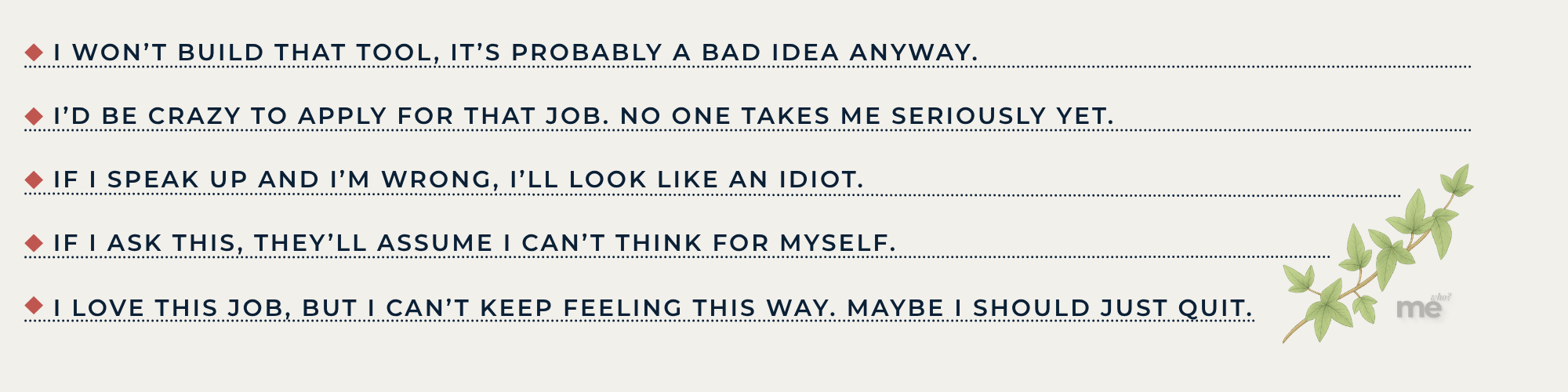
Imposter syndrome robs you of well-earned growth. It follows you from job to job, whispering that you’re not capable enough until you start believing it’s true.
Ask yourself: would you ever hire someone to follow your loved ones around, hurling insults at them every day? Tearing down their confidence? Of course not. And yet, when you listen to your imposter, you’re doing exactly that, but to yourself. The worst part? That bully isn’t some outside voice. It’s you.
This is a tough reality, but it’s a shared one. Research cited by the Mental Health Journal suggests that up to 82% of individuals experience imposter syndrome at some point. In fact, if you didn’t feel it at all, I might wonder if you were missing a key part of your moral compass. Imposter syndrome exists at the intersection of humility and self-doubt. The fact that you’re feeling it actually says something good about you. It means you:
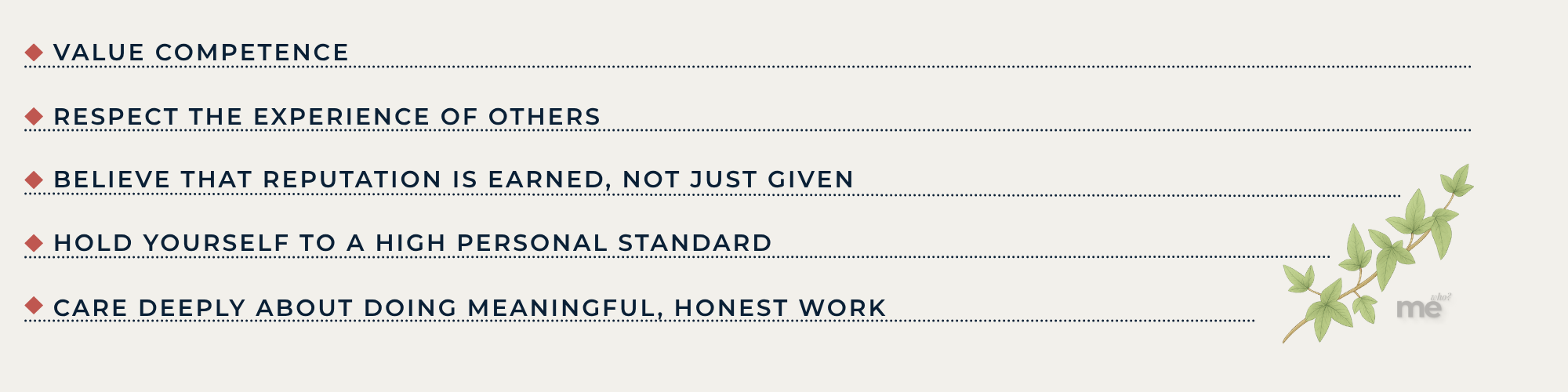
These are good traits, even if the balance isn’t always perfect. If you completely silenced your imposter, you might risk tipping into arrogance. Without any internal dialogue checking your assumptions or encouraging humility, you could miss valuable input from others. That’s not the point. Your goal is to find balance. To let your imposter speak, without letting it run the show.
Of course, none of this insight matters if you can’t spot your imposter in real time, and that’s the tricky part. How do you recognize a part of yourself that doesn’t feel separate—one that sounds just like you? In the next section, we’ll walk through a few ways to start identifying your imposter and building a more balanced relationship with it.
How to Get Over Imposter Syndrome at Work: A 4-Phase Guide
So where do you go from here? The hardest part of dealing with imposter syndrome is recognizing it in the moment. In the chaos of daily life, it’s easy to miss those flashes of self-doubt until you’re lying in bed, replaying your day and thinking about all the times you stayed quiet, second-guessed yourself, or held back. It’s not that you don’t notice—just that you notice too late. If only you could catch it sooner.
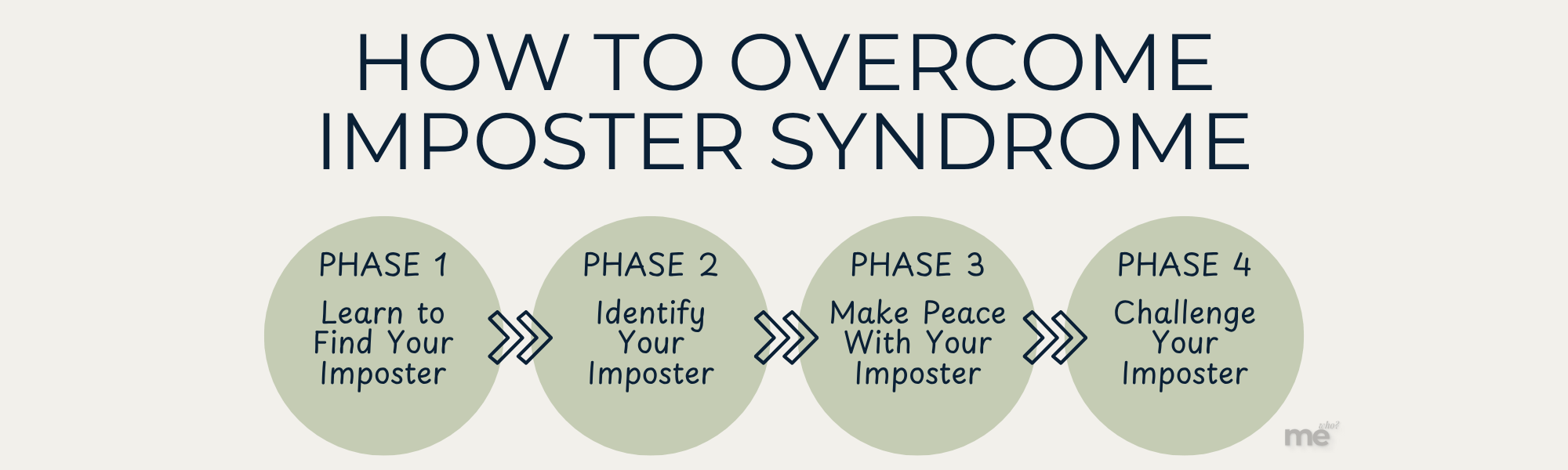
Phase 1: Learn to Find Your Imposter
Learning how to get over imposter syndrome at work begins with awareness. Journaling is one of the best tools to start recognizing your thought patterns. When you catch yourself ruminating after work—replaying moments you wish had gone differently—use that time. Grab your phone, open your notes app, and jot down what happened. It doesn’t need to be a formal journal entry. Just capture what you did, what you wanted to do, and where self-doubt got in the way. A simple two-column list works great: “What I did” vs. “What I wanted to do.”
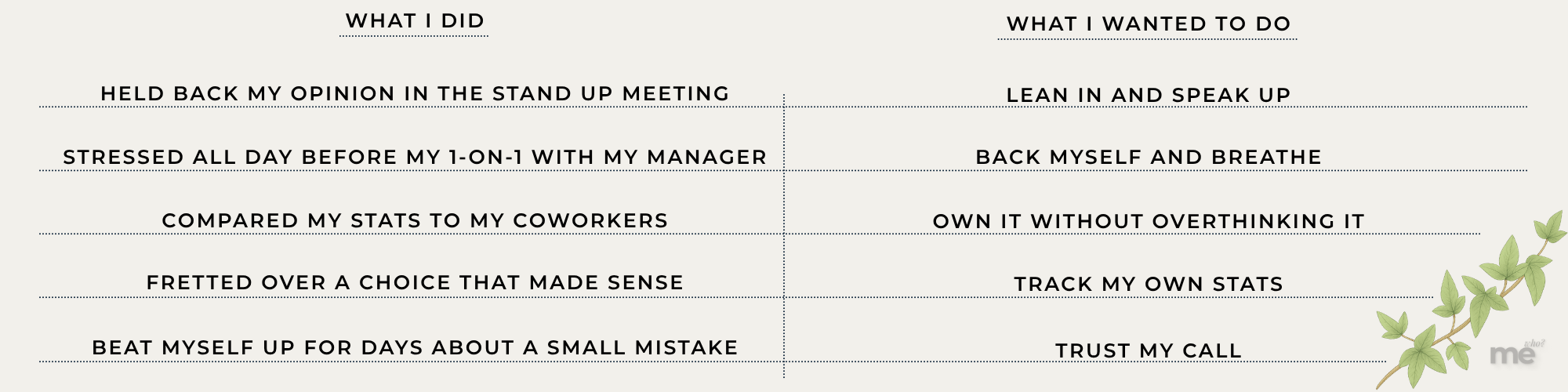
This practice trains your awareness to spot self-doubt sooner. At first, you might recognize it hours after it hits. With time, you’ll catch it within minutes, and eventually in the exact moment it shows up.
This habit also helps you move on. Once you’ve logged the moment, you give your brain permission to let it go. There’s no value in replaying a misstep over and over, but everything depends on being ready the next time self-doubt shows up. Each time you recognize it and respond with clarity, you build a kind of mental muscle memory. That’s what turns growth into momentum.
Once you can notice your imposter in real time—right at those critical decision points—you’re ready for the next phase.
Phase 2: Identify Your Imposter
Eventually, you’ll reach a breakthrough: the moment you recognize self-doubt as it’s happening. This is no small feat. Your imposter is subtle, slipping into your thoughts and guiding your choices without detection. Spotting it in real time is a skill, and when you finally do, it helps to give it a name. Any name will do. The point is to make your imposter feel separate from you, so you can call them out when you see them.
Naming your imposter does something powerful: it separates you from the voice of self-doubt. Instead of treating it like your own truth, you start recognizing it as a character that’s in the room, but not in charge. Let’s say you name your imposter “John.” If you hear John whispering things like “don’t speak up” or “you’ll mess this up,” you’ll be able to call that out, and maybe even laugh. That humor helps take away its power, and puts you back in control.
Humor is a powerful tool. When you can genuinely laugh in the middle of self-doubt, it takes the edge off. It breaks the illusion that the voice in your head is telling the absolute truth. When you recognize that it’s just “John” talking, you create space to respond with clarity instead of reacting from fear.
So, practice spotting your imposter and calling them out. When you can do that consistently, you’re ready for Phase 3.
Phase 3: Make Peace With Your Imposter
Once you can recognize your imposter in real time, you can begin to respond to it more thoughtfully. The key isn’t to silence it entirely. It’s to understand what it’s trying to tell you. These feelings show up for a reason, and sometimes, they carry a valid message—just delivered in the wrong tone. Your imposter might be trying to remind you that:
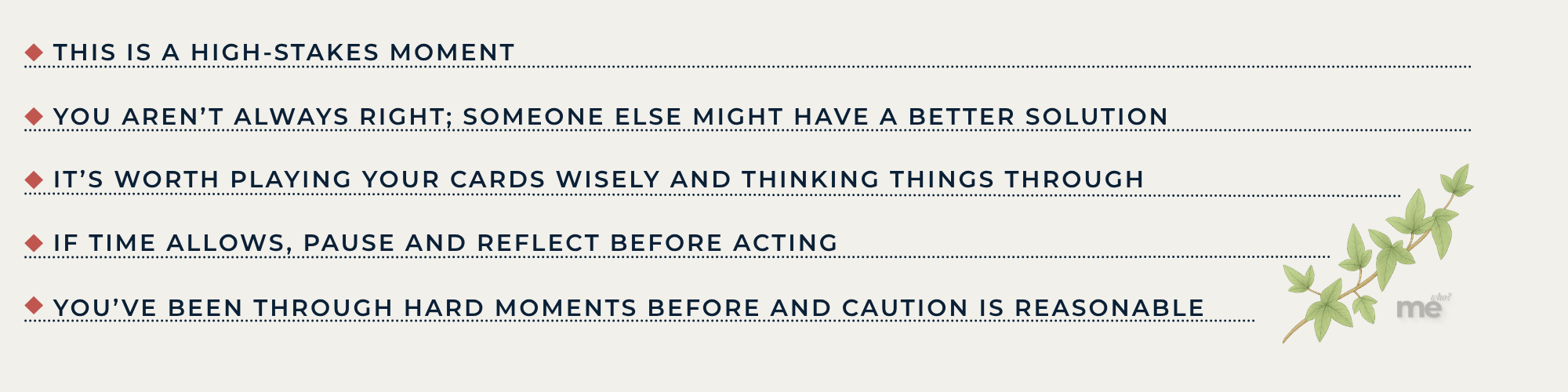
It’s okay to feel fear in challenging situations. In fact, you should. Fear exists to keep you alive. It reminds you that your actions have consequences. People who feel no fear often make reckless decisions, unaware of the risks to themselves and others. The goal isn’t to eliminate fear. It’s to understand it, respect it, and make peace with what it’s trying to say.
Once you’ve named your imposter, take time to understand its character. What is it afraid of? What advice does it give in moments of uncertainty? Does it usually tell you to stay quiet or play small? Imagine what your life would look like if this imposter always got its way. These moments are your chance to get clear on what you’re afraid of so you can develop responses that serve you better. The goal is to replace the self-doubt patterns you noted in Phase 1 with the confident actions you actually want to take: overcoming imposter syndrome at work one decision at a time.
Phase 4: Challenge Your Imposter
When it comes to fear, context is everything. A snowboarder threading through tight trees or steep, uneven terrain naturally feels fear—and that fear is useful. It signals real danger and helps prevent reckless decisions. Trust the fear too little, and you might enter a situation you’re not equipped to handle. Trust it too much, and you’ll never leave the bunny hill.

In a conference room or a job interview however, that same fear is often misplaced. The stakes feel high, but you’re not hurtling down a mountain. At worst, someone might laugh at your idea, you might struggle to sell your point, or—if things go really sideways—you might need to start or continue a job search. But that’s not life or death. It just feels like it when your imposter takes the wheel.
In most moments when imposter syndrome shows up, you don’t need to shut down. You need to push back. The fear might sound convincing, but that doesn’t make it true. Try responding with a little humor and defiance. If your imposter says, “People will laugh,” maybe your answer is, “I’ll wait for them to put down their coffee first.” It’s not about arguing with the fear—it’s about refusing to let it dictate your actions. Here are some quick call-and-response comebacks to try:
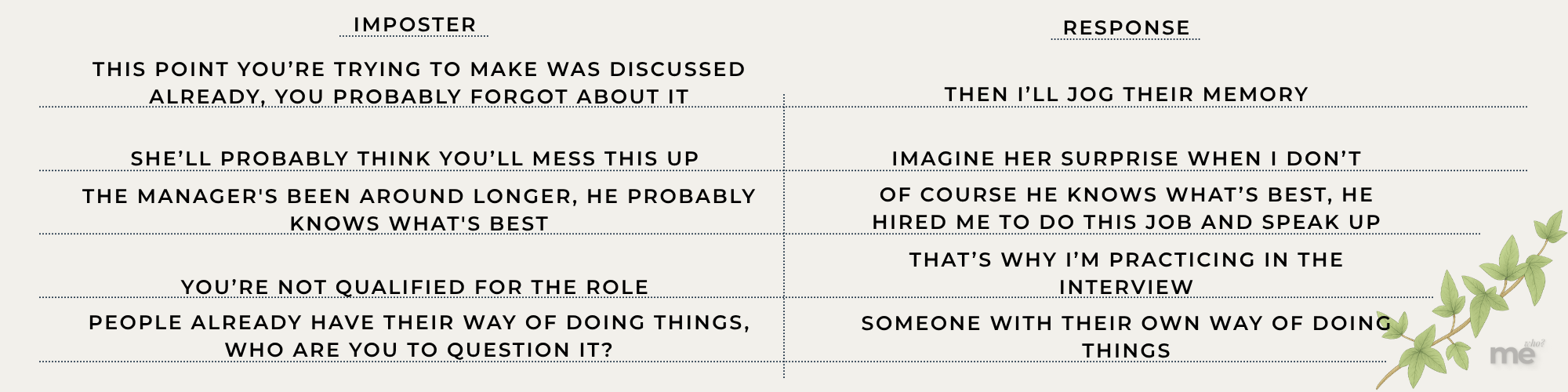
This takes practice and a lot of presence in your interactions. These moments can’t be fully prepped for ahead of time. Your mind might spin with what-if scenarios or rehearse what to say, but in the end, it all comes down to how you respond in the moment. That’s the only time it really counts.
I’m not saying things will always go your way. You might get laughed at in a meeting. Some people won’t like your ideas, but that’s not the point.
What matters is becoming the kind of person who speaks up anyway—who doesn’t dim their light just because someone else can’t see it. Your personal happiness depends far more on how you respond to your imposter than on the roadblocks other people place in your path.

From Self-Doubt to Self-Assurance: The Path to Lasting Confidence
The key to long-term growth is building the mental muscle to spot fear when it shows up and choosing to act anyway. At first, fear can feel like a command, but over time, you can retrain yourself to see it as a signal: a cue to lean in and take a chance. When you treat fear as a challenge instead of a stop sign, it becomes fuel. You start questioning it. Testing it. And more often than not, you’ll find it was wrong. Eventually, fear can even become a compass pointing you toward the next area you’re ready to grow.
Journaling is the key to this process and the thread that ties it all together. By consistently capturing what your fear is saying and responding with ideas that align with your values, you begin to reshape your thinking. Over time, you’ll build a mental rhythm that moves you toward the life you actually want. Think of your imposter as the last vestiges of your old life, gasping for air. Listening to that final breath is an act of compassion, and you can learn to do it every time it shows up.
Challenge yourself to spot five things your imposter tells you each week. Then, write a short prompt on how you plan to challenge each one. Keep that challenge top of mind. Check in with it daily. Use your imposter’s name when you reflect, and pay attention to what they’re saying. Over time, you’ll get better at responding with clarity and confidence, exactly when it counts.
The Collective Struggle: Why High Achievers All Experience This
It’s no surprise that high achievers struggle with imposter syndrome. Many of us grew up hearing that a “B” was a failure, that second place was just the first loser, or that success only counted if it was perfect. Those messages can create a deep belief that we’re never quite enough. Here’s the truth: you don’t need to overachieve to live a meaningful, fulfilling life. In fact, countless people with average resumes and modest ambitions go on to build incredible careers and find real happiness.
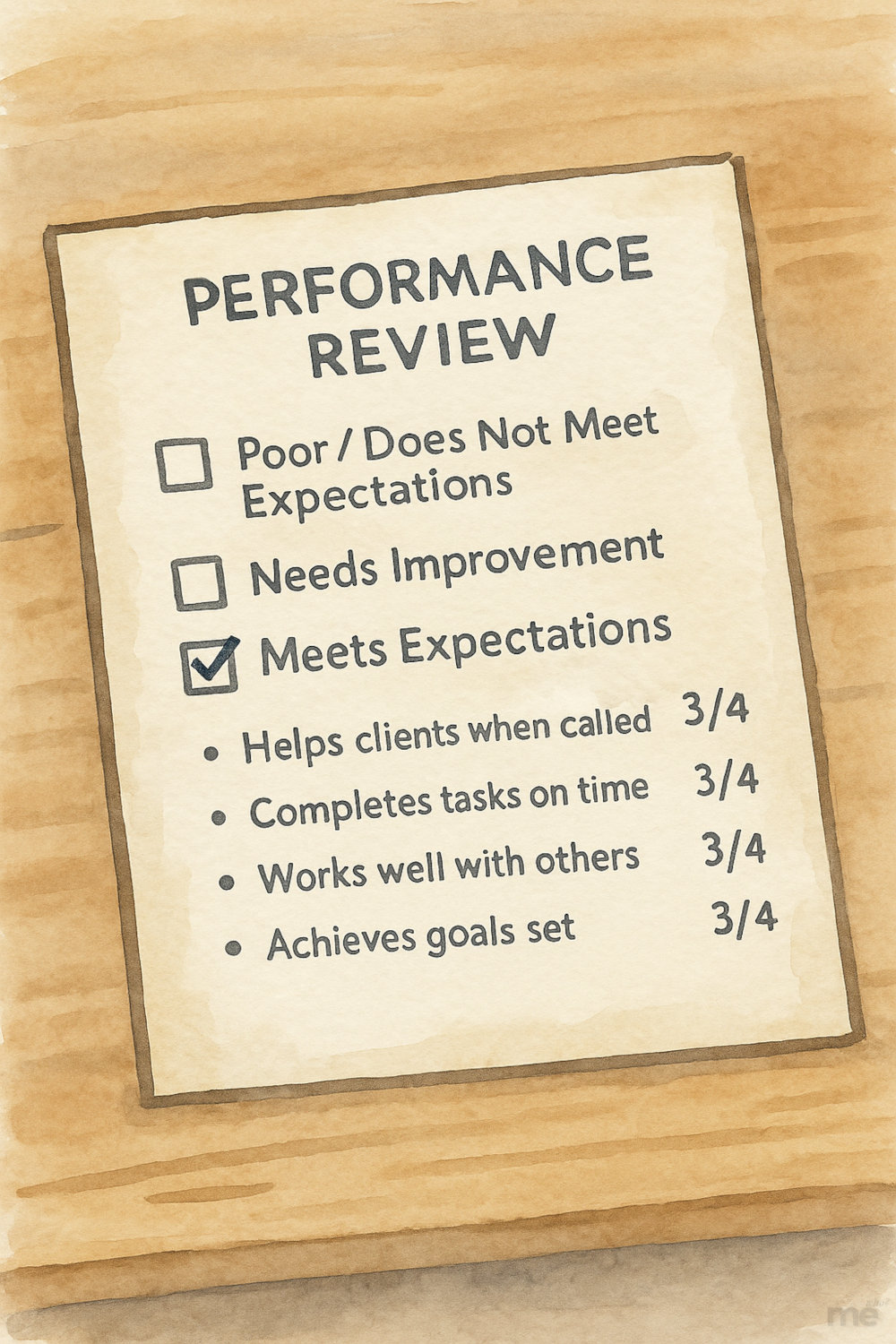
If anything, high achievers should feel deeply qualified, yet we often feel the opposite. Why? Because we were taught to chase perfection, and we carried that pressure with us into adulthood. We don’t just want to succeed—we want the voice to stop. So we chase goal after goal, even when the goalpost moves, hoping to outrun these painful thoughts. It’s not success we’re really after. It’s peace.
Let me say it plainly: you are more than enough to be living the life you’ve built. And here’s a secret: most people achieving alongside you feel the same doubt you do. Working through it doesn’t just help you grow; it gives others a model for how to face their own fears with courage.
You don’t need to believe you’re not enough in order to grow. That belief doesn’t serve your progress—it only slows you down. If you learn to see fear as a motivator, you’ll go way farther than imposter syndrome can ever take you.

Your brain thrives on dopamine rewards, so you have to give them to yourself along the way if you want to keep aiming high. Celebrate the process. Take yourself out to dinner after a tough win, or finally book the trip you’ve been putting off. The point of achieving isn’t to climb a ladder, but to build a happier, more meaningful life.
So if you’re not measuring progress by how much happier you are—what’s the point?
Conclusion
Identifying your personal imposter isn’t easy, but with time and effort, overcoming imposter syndrome at work becomes less about silencing fear and more about building confidence with every decision. This 4-step process helps you build habits that let you act in spite of fear. With time, you’ll apply it with confidence anywhere in your life that self-doubt tries to hold you back.
Imposter syndrome might sound like a rare affliction, but it’s something nearly all of us face. And when you learn to work with it, it becomes less of a roadblock and more of a catalyst for becoming who you’re meant to be.
How Does Your Imposter Show Up?
What about you? How does your imposter show up? Have you found ways to quiet that voice or challenge it when it speaks up? Drop a comment below and share what’s worked for you. Your experience might be exactly what someone else needs to hear.
hoee9b
j0ldke