

It’s easy to get lost in your mistakes at work. No matter your industry or role, there always seems to be an endless number of ways to screw up. Whether it’s a small oversight or a true emergency, your mind scrambles to figure out what went wrong so it can make sense of the situation. That scramble can leave you feeling like you’re the common denominator whenever something falls apart. Soon you find yourself stacking error after error and wondering why they seem to cluster. Before long, the answer starts to feel obvious: the problem must be you.
Making mistakes is how we grow into our roles at work. Nobody can be expected to perform flawlessly all the time. What matters most is how we respond in those moments. Progress comes from resolving errors and turning them into real experience in your field over time.
If you’re blaming yourself for every mistake, what does that do to your sense of progress? Do you feel yourself growing from the challenges you face at work? Or are you using each misstep as evidence that you don’t belong there in the first place? It can seem like everything at work is just another round of “how to stop blaming myself”.
If you’re having trouble stepping out of the self-blame loop at work, you don’t have to go it alone. We’ll walk through five ways to handle mistakes without using them as evidence that you don’t belong.

Why You Go Straight to Blaming Yourself
Mistakes at work never feel good, no matter how competent you are. The moment you realize you may have messed up, your mind rushes to find a reason. A familiar scan runs as you try to catch up:
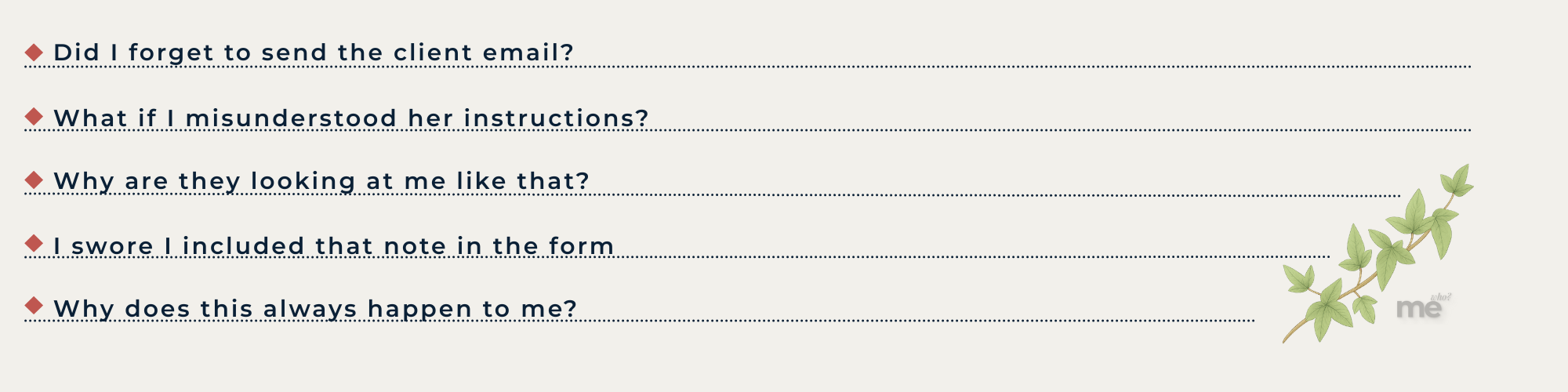
As the stress rises inside you, that scan deepens your conviction that you are the cause of the mistake. The interpretation gets narrower and more intense until it feels personal—almost like you did it on purpose.
At first, this is just normal problem solving. You try to find the cause of the issue in good faith, but somewhere along the line it becomes about you. Before long, you’re over-apologizing in meetings, taking responsibility for mistakes that weren’t yours, and selling yourself short out of habit. How does a sense of responsibility turn into an engine of self-sabotage in a moment?
When you find yourself in a tense moment at work, your mind grabs for a quick story that makes sense of what’s happening. It rarely includes the perspectives of others, or even your full read on the situation. Instead, your mind takes the first and easiest narrative that gives you a sense of control. Because your internal sense of pressure is racing, painful stories that cast you as the one to blame can actually feel like relief in the moment. They calm the spike of anxiety, but leave you badly prepared to deal with the problem long-term.

Three Faces of Self-Blame at Work
Mistakes at work tend to show up in a few familiar ways, and each one can nudge you toward the same self-blame story. No matter how big or small the situation, the same basic pattern plays out: something goes wrong, your mind hates the uncertainty, and it grabs the quickest story where you’re at fault.
All in Your Head
Most of the mistakes you make at work are ones you find on your own before anyone else gets involved. You might enter the wrong number in a form, then catch it later during your review. You might tweak a spreadsheet and later realize you need to revise it because you thought of a better approach. Sometimes the feeling comes as a near miss—you feel like you saved yourself at the last second before falling off a cliff.
These moments can seem to confirm that you can’t be trusted. It may even feel like if people knew how many errors you catch behind the scenes, they would never rely on you again. In that climate, it can feel like you have to stay in constant cover-up mode just to hide the fact that you get things wrong. Even when you correct your own mistakes, you still never get off the hook of blaming yourself.
Out in the Open
Other times, mistakes are caught in a team setting, like a business meeting or group review. Maybe a coworker points out a flaw in your work in good faith, or an email you sent to the whole team miscommunicates something important. Maybe a team review catches an error in a spreadsheet before it reaches the customer. Even if you handled the situation as best you knew how before it was caught, it can feel like everyone has quietly lost confidence in you.
When others see you mess up, the mistake feels more real. It can feel like you now have to work uphill to change people’s perception, or that they will be watching for you to mess up again. You may feel strong pressure to avoid mistakes at all costs for fear of confirming their doubts about you. The internal sense of being under suspicion starts to feel like a fact about the external work environment, even if that story only exists in your mind. It feels like you’re driving on an endless road that leads nowhere.

Real-World Fallout
Every now and then, a mistake truly is a significant event. You send the wrong payroll report and hundreds of employees go without pay. You forget to tell your manager you are going to be out for the day and something important gets missed. You mix up the dates for a client lunch and lose a high-profile deal. These situations are real, verifiable, and consequential. When they happen, it can feel like you have let yourself down and failed the team at the same time.
Even though very few teams actually fail because of the actions of a single person, these situations can feel like overwhelming evidence that reality is telling you that you are not cut out for your role. You might immediately feel like you need to switch teams or start looking for a new job. You might even frame it as protecting others from the chaos you believe you cause, even if you have done the job flawlessly countless times before. This time, the self-blame impulse seems fully backed by what happened, even when it still came from an honest mistake.
Regardless of the scale of the mistake, the only real difference is how amplified the feeling of self-blame becomes. That intensity does not tell you anything about whether the story is accurate, and it does not give you anything useful to do next.
When Self-Blame Grabs the Wheel
When you make a mistake at work, the self-blame spiral kicks in. It always starts the same way. A rising sense of pressure builds inside you as it becomes clear that something went wrong:
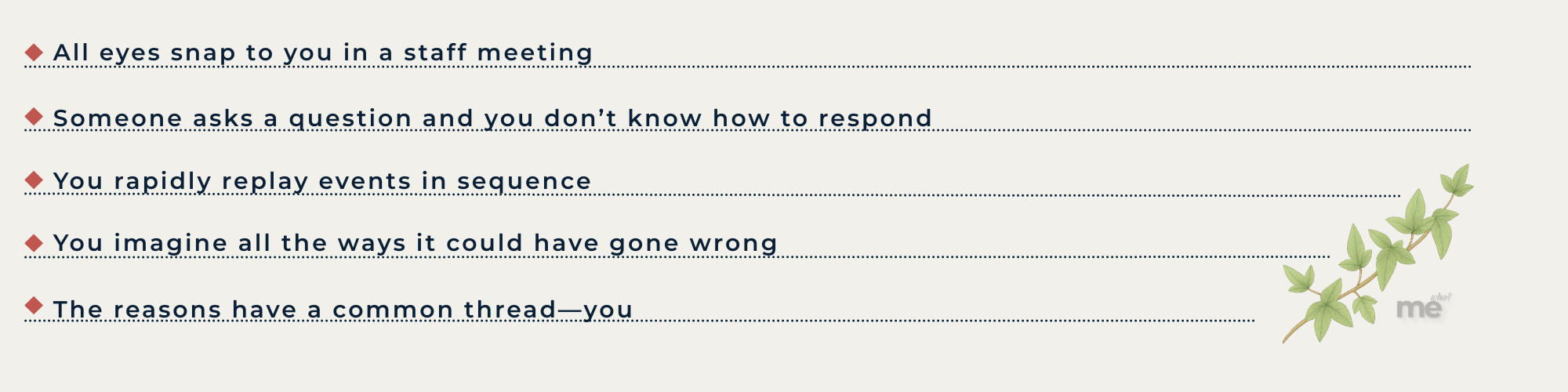
In this heightened state of awareness, the harder you scan for what went wrong, the more it builds an internal disconnect. Before long, you’re convinced: you did something to cause this. That assumption becomes the base layer as you keep building your story about what went wrong.
Soon you burst forth with your story. Maybe you over-explain in the meeting or try to explain the situation before you fully understand it. You think if you get ahead of things, you can make up for the mistake or assert some sense of control. Even before you confirm that you’re at fault, everyone is now looking at you.
You may have come from a good place, but when you look back, your reaction doesn’t look like taking accountability. It looks a bit over the top. Maybe you jumped to conclusions or assumed too much. Perhaps you’re working late that same night to fix a mistake you’re not sure you even made. By now it doesn’t matter. You’re convinced your reaction proves that you can’t trust yourself, or that you’re too sensitive. Maybe you make so many mistakes because you can’t control your emotions or keep things together at work. Every future mistake you make seems to confirm the same story, and after a while, it feels unmistakably true.

Step Out of the Story
Whether your reaction is directed at your coworkers or you quietly absorb the blame, the error is the same. You’ve acted before you have enough evidence to properly make sense of the story. The sense of threat in these moments is so strong that it feels impossible not to act on it. The intensity feels real, but that doesn’t make it true.
When you notice the impulse to blame yourself for something that goes wrong, feel the tension inside you. It’s evidence that you need to pause, not interpret what happened. In this moment, it’s enough to say, “A mistake was made,” and leave it at that. If you’re asked a question and you don’t know the answer, respond truthfully with what you do know, and be honest about what you don’t.
Allow time to figure out the full story before prematurely assuming it was all on you. If it turns out that you made a mistake, you can act when your inner threat detector has stopped spinning. When you calm down, you’ll have a clearer view of what you need to do. Pausing does not mean that you won’t take accountability. It means you’ll know exactly how much is truly yours to take. Just remember to see it, say it, shift it, whenever the feelings start to come on.

Five Ways to Stop Blaming Yourself for Everything
Pausing when your system is screaming to act is not easy. It can feel like the exact opposite of what you need to do. If you give it a chance, it can make all the difference in how you respond to mistakes.
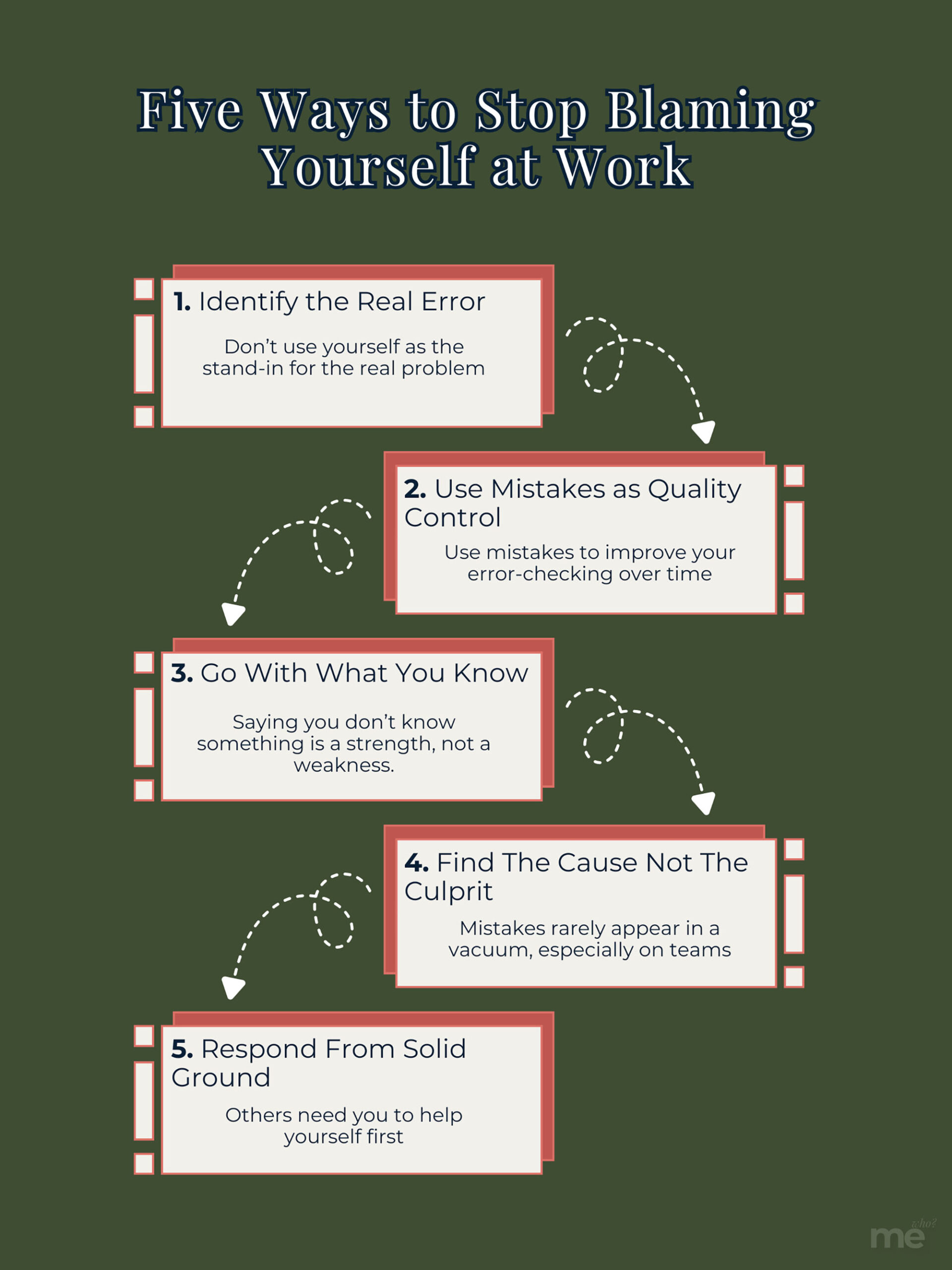
Let’s walk through five different ways of handling mistakes at work. Each one allows you to pause and wait for the self-blame impulse to recede before taking action.
Identify the Real Error
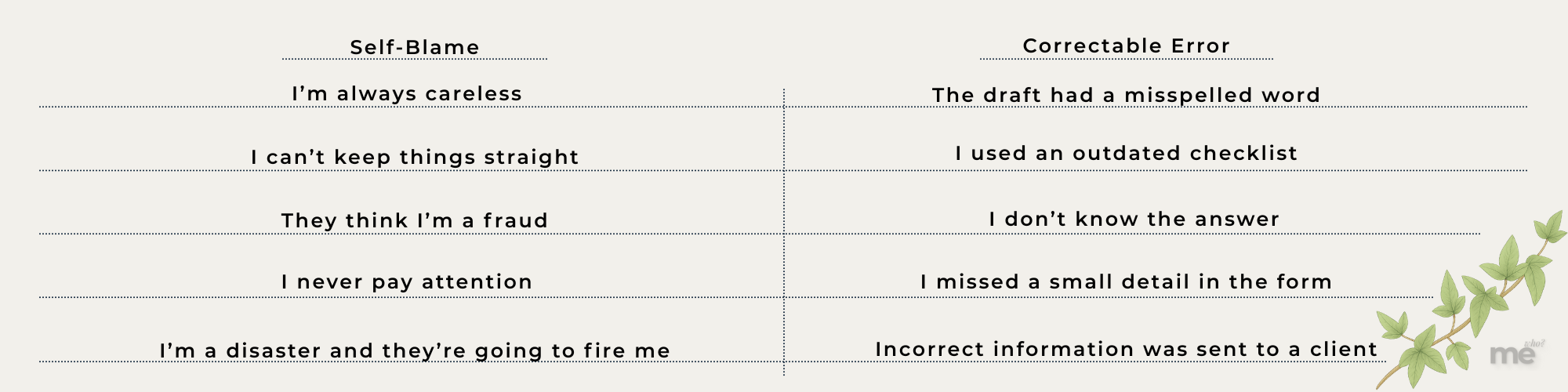
Discovering you made a mistake is a stressful event. When it happens, notice the urge to turn it into a story about who you are. When you see yourself starting to narrate the mistake into self-blame, pause and ask yourself: “What is the actual error here?” It’s okay if it’s not immediately apparent. It may take your mind a few seconds, or even longer, to identify the mistake as something you can resolve.
Here are some ways a mistake at work can be interpreted from a self-blame script into something you can work with:
Use Mistakes as Quality Control
It’s natural to leap from finding mistakes in your own work to assuming others see them too. In reality, everybody produces work with errors from time to time. Variations in your focus throughout the day, what’s on your mind, and how much sleep you get all play a role in the quality of your attention moment to moment. You can rest assured that your coworkers are not tracking how often you make mistakes in your internal process.
Instead of viewing your mistakes as a personal flaw, treat them as a reflection of your routines at work. Are you making frequent typos? Are you often sending out incorrect information? If you can identify patterns in your mistakes, you can build checks into your process that help you catch those same errors before you send your work out to others.
With this mindset, you can train yourself to build a system that assumes you’ll make mistakes and has room for them. Every time you pause and ask, “How can I catch this next time?”, you allow yourself to design error correction into your daily routine. You can learn to see your personal mistakes as a constant tweak on your quality control process, not a verdict on your worthiness.

Go With What You Know
Most professionals have been in the uncomfortable position of being put on the spot in a meeting. Many can tell a story of being called out in front of a room when they were not prepared to face a mistake. It’s a familiar urge to rush to explain, deflect, or do anything prematurely to resolve a situation before you have all the facts.
The willingness to pause in that tension and say you don’t know is a strength. There is no weakness in admitting when you don’t know something. If you can be honest about your limitations in a high-pressure situation, you take the first step toward resolving the issue. Even if it surprises others to hear that you didn’t know something, they are at least getting the truth. Trust that a real solution can arise from there.
Find the Cause, Not the Culprit
When a mistake surfaces in a public meeting, it can feel like an automatic scan is looking for blame. Everyone in the room feels it. The Eye of Sauron seems to land on each person in turn. The pressure feels intense—as if identifying who is personally responsible is crucial to solving the issue.

In reality, when a team fails, it’s almost never because of one person’s mistake. Teams rely on systems and processes to catch and correct errors so the organization can do its job. When a mistake reaches a customer or leads to another serious outcome, many things have likely gone wrong in the process. You may have had something to do with it, but that does not make you solely responsible. Teams that take accountability collectively can find and solve real issues more effectively instead of looking for someone to leave holding the bag.
If you notice this dynamic unfolding in a meeting, you can offer a gentle leadership move by shifting the focus toward the actual cause of the problem. Try to steer the conversation away from “who” caused it and toward “what” broke in the process. At the same time, accept what you could have done to prevent the mistake, without assigning self-blame. Far from looking weak, this gives other people a social signal that it’s okay to take accountability without becoming a target.
Respond from Solid Ground
Every airplane traveler knows the saying: “Put on your own oxygen mask before helping your neighbor.” This is not selfish advice—it is hard to help others if you’re unconscious.
In a similar way, there can be a strong rush to help other people when you feel the self-blame impulse. It can seem like taking total responsibility or rushing in to solve things is an altruistic act, especially when your sense of internal threat is rising. You might even unconsciously feel like you’re saving others from that feeling. It’s a noble impulse, but if you rush forward on bad information and propose the wrong solutions, you are not really doing much to help the situation.
If you don’t fully know what is wrong yet, waiting for your instincts to catch up to reality is a sound response. It shows you trust yourself to act from the right place, not just the first place.
Let Mistakes Work for You, Not Against You
No one enjoys messing up at work. Try as you might, you’re never going to reach a point in your career where you don’t make mistakes. Screwing up is a natural part of being human. The more you build mistakes into your plan, the less likely you are to swap in self-blame as the story when they happen.
Each time you learn from a mistake at work, you’re developing skills and experience that can:
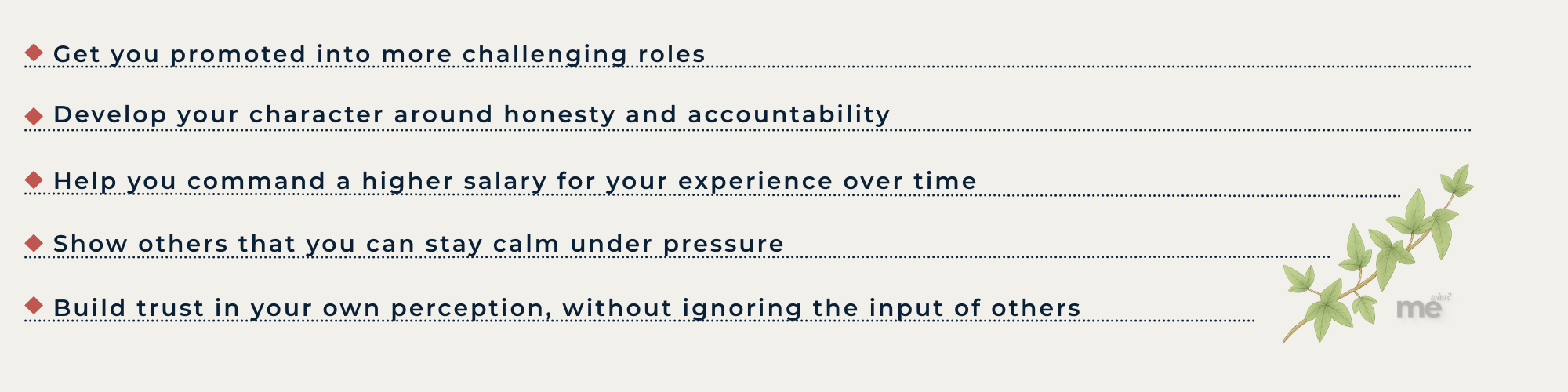
The goal is not to avoid mistakes, but to fold them into your experience so they are less likely to repeat. This is the foundation of leadership. When others can look to you as someone who can calmly respond to mistakes and suggest solutions, you become someone they naturally orient around when the pressure rises.
With time and repeated practice, you’ll build confidence that you can weather any mistake at work. You may even find that they show up far less often than they used to.

Conclusion
Learning how to stop blaming yourself when you make a mistake is a practice you can master over time. When errors compound, it can feel like there is no better logical reason than “it must be me”. Learning to reframe self-blame into real tools you can work with at work can give you a chance to respond to mistakes clearly—without making it all about you.
Everyone makes mistakes at work. The real question you keep asking is how to stop blaming myself for everything. Put the self-blame habit to bed for good so you’re not defined by the mistakes you make at work.
See the Spiral Up Close
If you want to learn more about how the self-blame spiral hijacks your workday, check out our deep dive on the mechanism behind blaming yourself for everything at work—and step out before it takes over.

0 Comments