

Do you find yourself constantly blaming yourself when things go wrong at work? Do you wake up with a low-grade sense of dread, already wondering what mistake you’re going to make today? Maybe you’re just tired of feeling like it’s always your fault when things don’t turn out right at your job.
Whether you’re the go-to person who “never” makes mistakes or someone who slips up from time to time, it’s often easier to turn the blame inward when things don’t line up at work. It doesn’t help that a lot of people around you don’t want to own up when they fall short, which leaves you feeling like you always have to be the adult and take responsibility. It sounds noble, but this pressure can have you taking accountability for everyone’s business at the expense of your own.
This habit of blaming yourself is exhausting, even on days when nothing serious goes wrong. No matter what happens at work, you can always find something you did that could have improved the situation. You replay the moment over and over again. You remember what each person said, what you were thinking, and how you responded. Things you wanted to say but didn’t. There’s a familiar pattern when things start to go sideways, but you have no idea what to do about it. Worst of all, it’s hard to discern what’s truly within your power to change when you’re constantly blaming yourself. When everything looks like your fault, it becomes harder to see what you can actually do about it and easier to fight to ignore it and stay stuck in defensiveness.
If you’re feeling trapped in the cycle of blaming yourself whenever something goes wrong at work, you’re in the right place. Tons of ambitious professionals find themselves in the habit of blaming themselves instinctively every time something goes awry at their job. In this article, we’re going to break down where this harmful emotional pattern comes from and give you some grounded strategies to shift course any time you notice the self-blame spiral spinning up during your workday.

When “Blaming Myself” Becomes Your Default Setting
You feel the tension rise, like the whole room is waiting for someone to make sense of the confusion. Something clearly didn’t go as planned. Before you know it, you’re rushing to fill the silence, offering that you could have done this or that better. You try to be the first to make a good-faith effort to resolve the situation. Maybe you expect someone else will feel it too and chime in with something they could have done to prevent it. Nope. It’s just you holding the ball.
Sometimes all of this only happens in your head. You start quietly blaming yourself, hoping no one else will notice or decide you’re the cause. Maybe you don’t even know if it’s your fault, but you’ve been trained to find it in yourself first, even preemptively. With that kind of tension in the room, you don’t need anyone else to blame you before you start to feel like it’s probably you after all.

Other times you don’t even get that much choice. Your team has already gone through the motions of blaming you before you’ve had a chance to figure out whether you really had a role to play. When you’re in that kind of environment, it’s even harder to separate the self-blame story from the facts, because everyone around you seems eager to agree with it.
How Self-Blame Shows Up and Weighs You Down
What do these situations have in common? The same insistent pull to cycle inward and look for blame inside yourself. Whether you take too much responsibility, shut down in fear, or end up as the office scapegoat, the thread running underneath all of it is your willingness to stop at nothing to define yourself as the problem. Sometimes blaming yourself smooths things over with coworkers. Sometimes it fuels a quiet, paranoid defensiveness, even when your performance is fine. Here are five ways self-blame can show up in your workday:
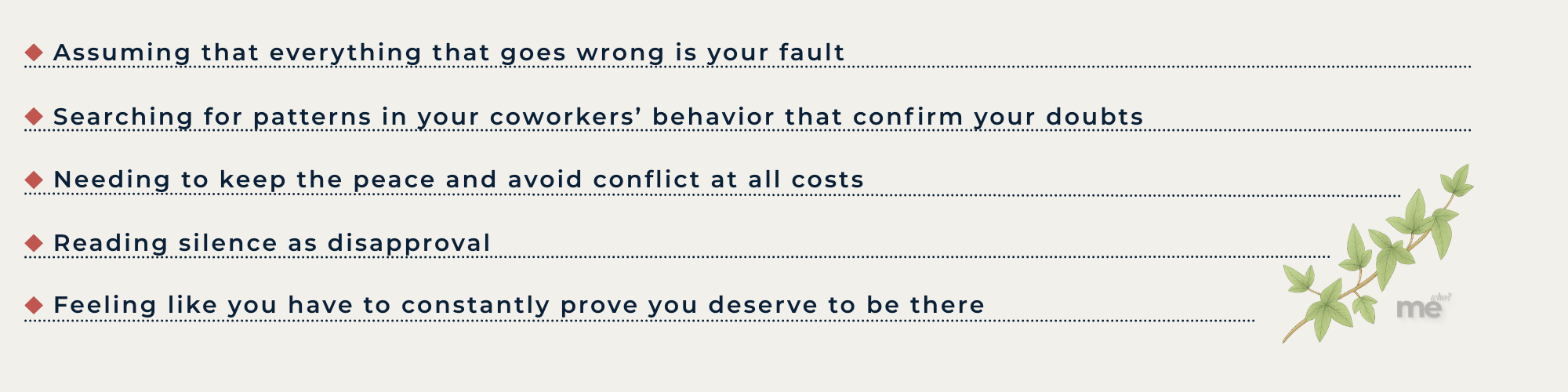
Over time, blaming yourself becomes a familiar burden. Maybe you second-guess all your work, make impossible demands on yourself, or just spend way too much time doubting your choices. It starts to feel like there’s a running list of places you’re not meeting the bar. Even if you know your own expectations are part of the problem, it often feels like someone outside you has to set a standard that disproves your self-blame. Then maybe you can finally relax and it can stop running your life.
How Blaming Yourself Warps Your Story
The standard you set for yourself is important, but it can also be a double-edged sword. Many of us find it easier to scan inward and look for our own role in a situation because it gives us a sense of control. That instinct isn’t automatically a problem. In almost every situation you look back on, you can spot something you could have done or said differently that might have led to a different outcome. That isn’t necessarily rumination; it’s self-reflection. It’s how we grow and learn from the situations and encounters we face. We need to be able to look back and learn so we can make more grounded decisions in the future. The willingness to look inward for a solution isn’t a mistake; it’s a willingness to admit you don’t have all the answers.

If self-reflection is so important, why is self-blame such a miserable habit that keeps ruining your workday? The key difference is the intensity and weight you put on the impulse to go inward. Think of it like adding salt to a stew: just a little and it’s seasoned and delicious; too much and you can’t taste anything else.
The same principle applies here. You can cycle inward just enough to pull out the information you need to guide future action, and then you have to accept and trust the version of you who acted with that limited information at the time.
Let’s look at a few examples of how the same inward impulse can shift from out-of-proportion self-blame into healthy self-reflection.
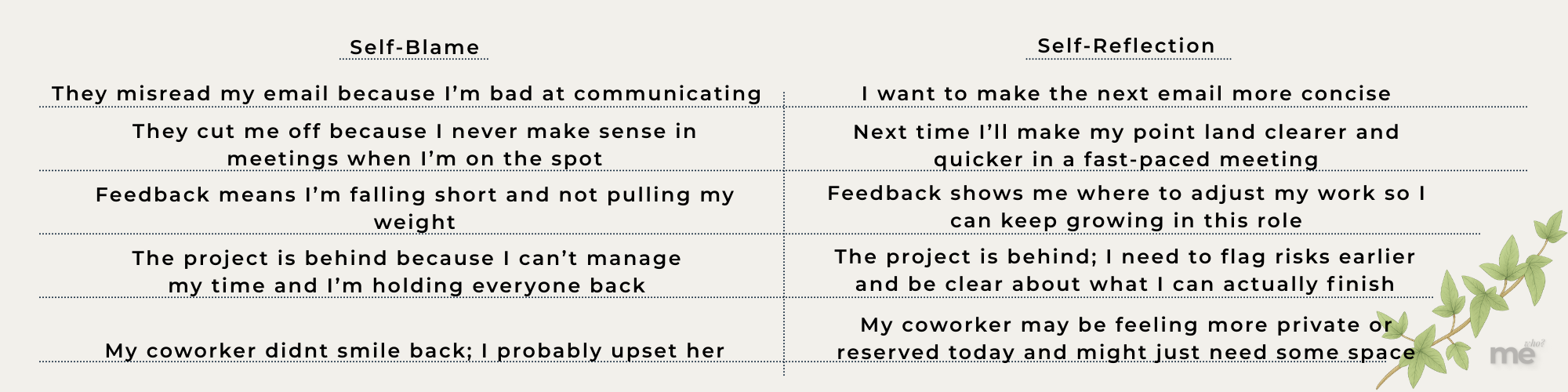
Notice how the same inward impulse is at work in both columns. In the first, the problem becomes you: a fixed flaw in your identity. In the second, the reflection stays grounded in the situation you’re in. The second version is tunable and actionable; the first is a distortion that inflates a small moment into something that feels real and unchangeable about you.
Whether you rambled in a meeting or weren’t clear in an email, you can do something about those situations, but if you decide you’re a terrible communicator or the kind of person who always shuts down in meetings, there’s nothing concrete to work with there. You’ve already decided who you are from the feedback. From there, you’ll defend that story and find evidence for it no matter what you do, as long as you keep defining yourself with vague labels like these.

When Stone-Age Wiring Meets Office Politics
Even if you know, in theory, that these amplifications aren’t true, it’s hard to remember that when you’re bumping into the same habits day after day. It can feel like someone is following you around, yelling at you to be a better person with no clear direction on what that means or what to do. It’s even worse when your coworkers are given an easy way to agree with your self-criticism, especially if you’re the one volunteering to take the blame. When you’re constantly being told you’re incorrect or that you’re the cause of everything that goes wrong, whether by yourself or by others, you’ll find a way to believe it and unconsciously make it come true.
This isn’t proof that something is wrong with you. It doesn’t mean you’re weak, that other people are stronger, or that you’re “too sensitive” or any of the rap. What it does mean is that your system has adapted over millions of years to treat any feedback that feels dangerous—internal or external—as something to act on immediately, without much question.
For our survival-oriented species, that wiring was very useful: anything unfamiliar or unsafe that could harm or kill you had to be prioritized in your awareness. Today, that same wiring means we can turn fairly benign situations—a meeting, a deadline, a mistake on a project—into an existential crisis. We start defining ourselves according to the threats we think we see in our environment.
These modern triggers can feel every bit as intense as the threats we faced in the natural world thousands of years ago, but most of the time, they don’t actually carry the same survival weight. It’s our interpretation of those threat signals that becomes the primary risk now, not the situations themselves. If you believe every internally generated story and blow up at your manager, are you actually creating a safer long-term situation for yourself by acting on those “threats”? What ends up becoming the real threat to your career?
It’s one thing to analyze a crisis; it’s another to notice the tiny micro-moments that reveal how you’re interpreting feedback. Are you treating events as fateful identity scripts, or as information about how to move through your environment and accomplish your goals?

Every Road Leads Back to You
When we have a meltdown or explode over a work situation, it’s easy to look back and see a convergence of a million things going wrong at once. Ironically, instead of recognizing that an eruption like this comes from many factors, we get overwhelmed and start hunting for one simple reason to explain what happened. That often makes self-blame the simplest way our minds try to reconcile a complex event.
A more accurate explanation would include the parts that were outside our control, but the mind still often finds relief if it can generate an easy narrative about what happened. This happens even if that story is painful or flat-out wrong; it gives our minds somewhere to land to try to make sense of the situation. Our view is limited to our angle, and an easy story rarely sees all sides. This is why it can feel safer to identify yourself as the threat, even when the truth is more complex.
You may not see the stress in your coworker’s family life that led to their outburst in the hallway, or the pressure your manager’s boss put on them right before your performance review. You may not understand why your mentor put off your invitation to lunch, or why you got that weird glance from a new coworker when you were trying to explain a concept.
If you’re used to explaining these moments with an inner story that quietly casts you as the cause—even when you’re not—it can be startling to realize how often you might be getting it wrong.
Let’s walk through a typical workday and look at five moments where the self-blame spiral quietly alters your course.
The All-Day Blame Game
You wake up on Monday morning and realize your alarm never went off. You spent part of the weekend telling yourself this would be the week you finally get it right, but you’re already an hour behind and off to the wrong start. There isn’t enough information yet, but your mind immediately scans for the problem:
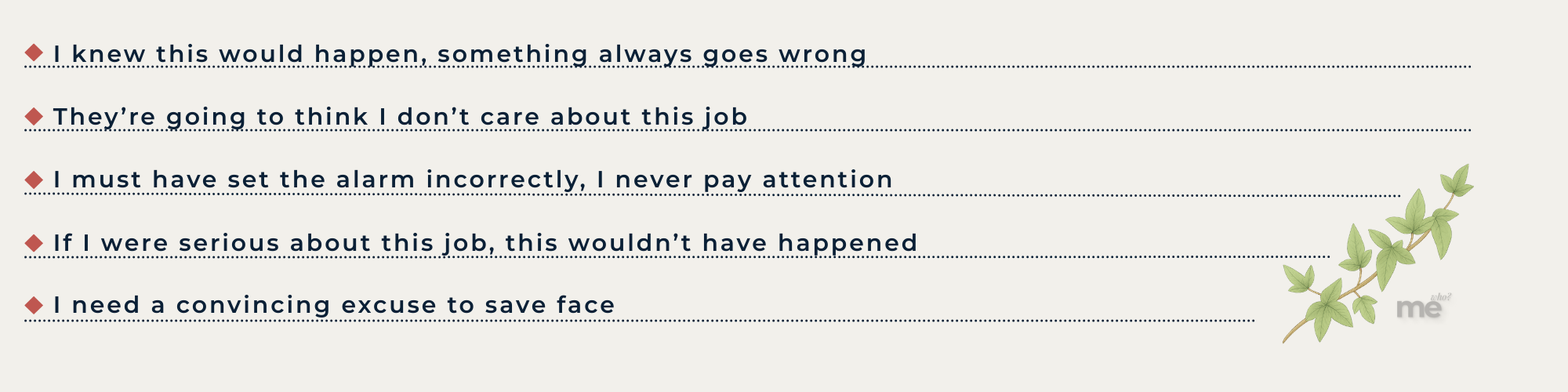
While all of this is happening, you yank the alarm clock out of the wall too quickly to notice the blinking display. The power went out sometime overnight. The real story had nothing to do with you, but that’s far too simple for your spinning mind to accept when everything feels charged and tense.
By the time you arrive at work, you’re already defensive. No one really notices you’re late, but you make sure to preemptively tell everyone that traffic was awful. Maybe the car didn’t start, or you hit an icy patch. The story feels forced and oddly detailed.
Everyone but you is aware that every time you’re late, there’s some dramatic explanation, even though they’re often late for small things too. You think you’re being convincing, but it just makes people second-guess what they would have otherwise ignored.

By lunchtime, the tension is still riding high. The urge to prove yourself is stronger today, so you impulsively decide that this afternoon’s staff meeting is the perfect time to pitch a completely new idea you’ve barely thought through. If it lands, maybe it cancels out the fact that you can’t even manage to show up on time.
When you start talking in the meeting, thoughts come out in a jumble. It might be a good idea, but who could tell? You didn’t prepare any slides, and the room mostly just wants you to stop repeating the same phrase continuously—it isn’t helping anyone understand your point. Never mind that your idea doesn’t fit the agenda; it’s coming out with so much pressure that people can’t focus on the content.
The meeting fizzles out. Your impulsivity has smothered an otherwise good idea under too much urgency and self-pressure.
You head back to your desk and, with almost magical timing, your computer decides it’s time to update. The reboot wipes out some of your work. You now feel even further behind and forget to follow up with a colleague before the end of the day. A couple of other small details slip through the cracks under the weight of the frustration and confusion you feel about how the day is going.

With each attempt to fix things, you dig yourself a little deeper. It starts to feel like all these random events are converging to sabotage you—and your inner voice starts to believe and repeat that story.
Of course, your computer isn’t out to get you, but the lost work seems to confirm that you can’t do anything right and that no one wants to hear what you have to say. You spend most of the drive home rehearsing the story over and over.
When you finally get home and burn dinner because you’re fully lost in the blame cycle, you lash out at the stove as if it’s trying to prove you’re a bad cook. Everything seems to point to the same conclusion. If you manage to get any sleep tonight, the last thing you say to yourself will seal the story shut. There’s never a moment to seriously ask: why am I always blaming myself?
Seeing the Self-Blame Loop
Whether you’re a seasoned professional or new to the working world, you probably have days where self-doubt quietly takes over your thinking. On a day like this, it can feel as if everything is going wrong, even if there are only a few real errors. What really does the damage isn’t the errors themselves; it’s the story we create around them.
In the example we just walked through, only five moments were actually misread:
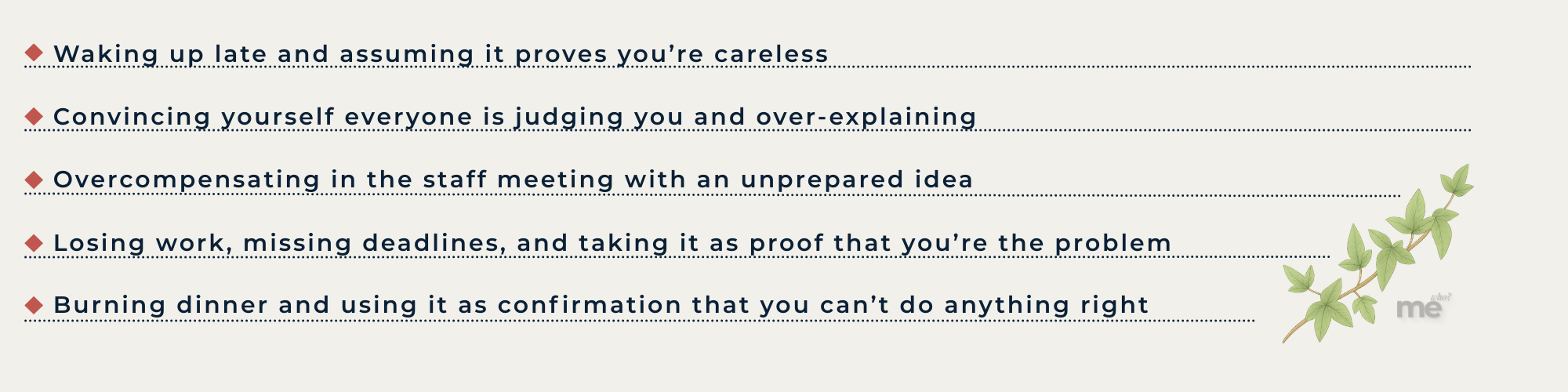
By the time you go to bed on a day like this, you’ve collected plenty of “evidence” that you are the common denominator. Those five distorted error moments have now grown into a sweeping story about who you are. That story also tends to generate some pretty harsh ideas about what the solution must be. If the problem is you, should you just leave or quit? Maybe you’re fundamentally flawed and can’t grow. Maybe you’re weak or too sensitive.
These interpretations aren’t correct, and they don’t support your long-term well-being. They come from misreading your role in events, like looking through a warped lens that makes your image bigger or smaller than it really is. In a perfect world, you’d be able to step back in every difficult moment at work, see the whole picture, and know every variable before you respond. Real life doesn’t give you that clean a view. You rarely have all the information, and even if you did, you still wouldn’t always have the time to form a fully coherent response in the moment.
This isn’t hopeless to change. The question is what to do with it. Those five situations all follow a repeatable pattern, and you can learn to recognize it while it’s happening.

Internal Alarm Goes Off
You feel something work-related that lands as a threat. Maybe you see the time on the clock as you are running late, or you catch your coworker’s annoyed expression when you arrive. Your heart rate jumps and your chest tightens. It is as if an alarm is going off in your head. Your mind starts racing to resolve the situation. It does not feel like a choice. It feels like your stomach is being pitched upward as the roller coaster whips you around the corner.
Stories Rush In
Your mind throws everything it has at the wall to explain what is going on. That means reaching for a quick, convenient story, even when it is completely off-base:
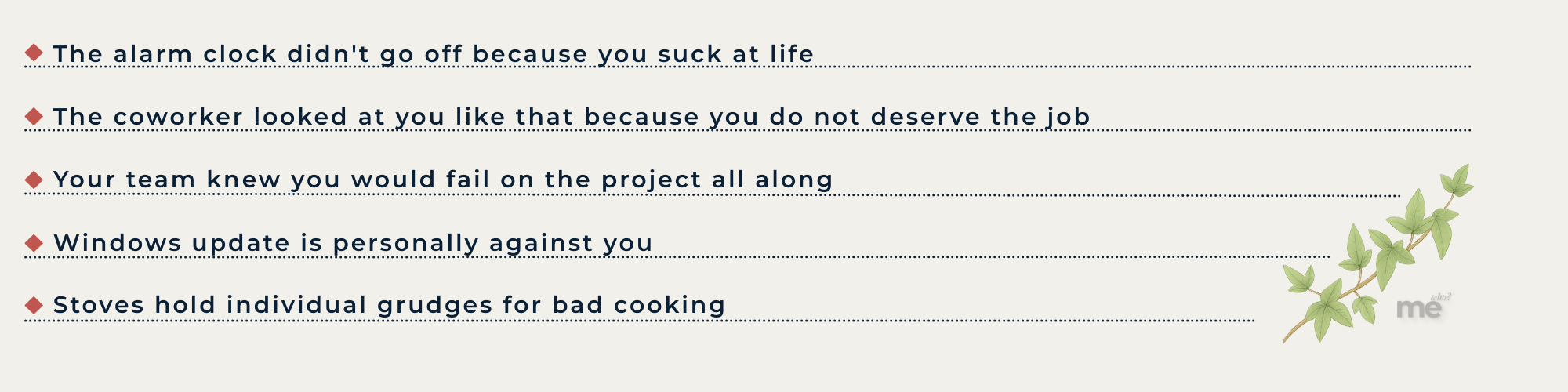
You may be able to laugh at these interpretations now, but they’re no joke while they’re happening. They feel real and personal. The story makes sense in the context of a very real felt sense of threat, and because it matches the internal charge, it is easy to accept it as the truth.
You Make It Real—Inside and Out
No time to check whether the story you grabbed is accurate. You’re going with it. You over-explain in a meeting. You react defensively to feedback in a review. You apologize over and over. You blame yourself and rush to overcorrect. On the worst days, you might even explode on a coworker or manager.
All of these reactions come from the belief that the interpretation you made was real and that you need to react to protect yourself. Every reaction feels proportionate to the urgency and charge you felt when you made it. When you’re in it, it does not matter how true the interpretation is, only how real it feels. Your reaction comes from a place of lived frustration, and it feels like jumping on it will actually solve the problem.

Fallout Seals the Story
Once you think about your reaction, it no longer feels proportional. It feels like it may have been an outburst. Maybe you jumped to conclusions. You may start to believe you can’t trust yourself to stay calm in high-pressure situations or that you don’t have what it takes to respond well to stress.
Although self-blame was the dysfunctional pattern the entire time, it seems to have confirmed itself as irrefutable truth. You reach the end of this cycle, look back, and the only thing that makes sense is that you were right about yourself all along. The pattern gets reinforced. Your system files it away as “how things are,” and guess what? You get to play this out all over again tomorrow.
The Mirror Tunnel: What This Does to Your Self-Image
Imagine you are standing in a hall of mirrors. When you look down the row at just the right angle, you see a long tunnel where the image seems to repeat. There is a version of you in each mirror, bending along the arc. Each successive image appears smaller and less detailed as it recedes into the distance.
Which one of these is the real you? Is it one of the images or all of them? What if it’s none of them?
Consider each layer in the mirror as one more layer of abstraction on your self-image:
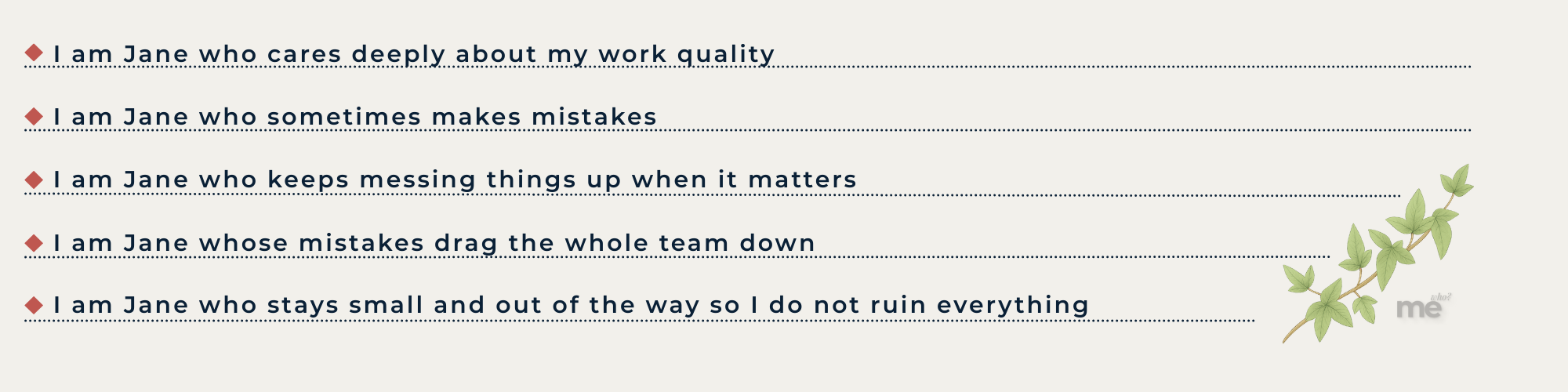
Each layer appears to offer more clarity, but each reflection actually contains less information about the original image, not more. That is why the reflection looks fuzzier the further down you look into the mirror tunnel.

When you apply this same kind of layering to your self-blame story, it can create a heavily distorted view of who you are and push you toward the wrong solutions. In this kind of distortion, you end up treating social anxiety with more isolation, self-blame with more shame, and every situation seems to confirm that something must be wrong with you. There has to be a better way to respond than treating this distorted story as literal truth.
Put the Spiral in Neutral
When you feel the spiral of self-blame starting to rise, the whole sequence can move fast. You might find yourself reacting before you fully register the trigger or notice the story forming. The key in these moments is to notice the exact point where you become aware that you have started down the familiar spiral. Pay attention to the urge to react outwardly and fix the situation. Feel the tightness in your chest as you notice yourself starting to form a response.
Right at that moment, you have a choice.
You can keep following the self-blame spiral and believe everything it says about you. You can dig deeper, staring harder into the mirror tunnel and trying to decide which layer shows the “real” you. You can search for interpretations that support the blame story at deeper and deeper levels and keep digging for an escape that never quite arrives.
Or you can recognize that this is not useful and pause. Imagine your mind shifting out of drive and into neutral. When you feel the interpretations start to spin, you can choose to do nothing at all.

It sounds simple in theory, but it’s one of the hardest moves to make when every part of you is screaming to act. Choosing not to react is not a passive response. It is a demanding, dignified response to internal pressure.
When Doing Nothing Means Everything
When you decide to feel the self-blame spiral rising and choose not to respond, you are not dismissing your perspective or invalidating your experience. You are choosing not to act on limited information. You are trusting your mind to enter a holding pattern instead of reacting to a premature interpretation of a threat. You are committing to respond once your system has stepped back from full alert, not while you are still in threat-scanning mode.
This creates space for your mind to integrate what is happening before you respond. The self-blame pattern is strong and will try to inject itself anywhere it can. When you allow time to see the bigger picture, it becomes harder to interpret every event as entirely your fault.
That is the whole move. Feel yourself start to climb the blame spiral. Notice the familiar catastrophic arc—and just as you feel yourself about to react outwardly from that place, hold it right there. Shift your system into neutral, allow yourself to coast through the moment, and wait for your system to spin down naturally. Before long, you will know how to respond from a steadier place.
When the doubt rises up, just remember to see it, say it, shift it!

Making Neutral Your First Response Under Pressure
This can feel almost too simple for a high-pressure moment, but you’d be surprised how well it works. On the surface, it goes against logic: when you feel the pressure start to rise, every part of you is screaming to act. Self-blame is a fast, automatic process; the response forms so quickly it feels instinctual. The reactions are so familiar that you can start to mistake them for who you are, strengthening the story every time you run through the blame cycle.
Making this move is not easy at first, and it takes practice to reach for it when the feeling shows up. Each time you choose non-reaction in the face of a rising sense of threat, you’re casting a vote to evaluate the situation and respond from clarity instead of impulse. You buy yourself time to form a coherent response and put your reaction back in your hands. You’re no longer at the mercy of your impulses or other people’s reactions, and you do it while still noticing and honoring your experience of events without denying or collapsing it into blame stories.
If you fall short in catching yourself and find that you’re already spinning, don’t fret. Nothing is lost. The moment you notice that you’ve gone up the spiral is the moment you can play your new hand.

Like lifting mental weights, you’re training yourself to wait for clarity to catch up. Now look back at the five situations from the previous section and see what this move looks like in real life. It’ll take time to build trust in your own version of this neutral maneuver in each kind of situation.
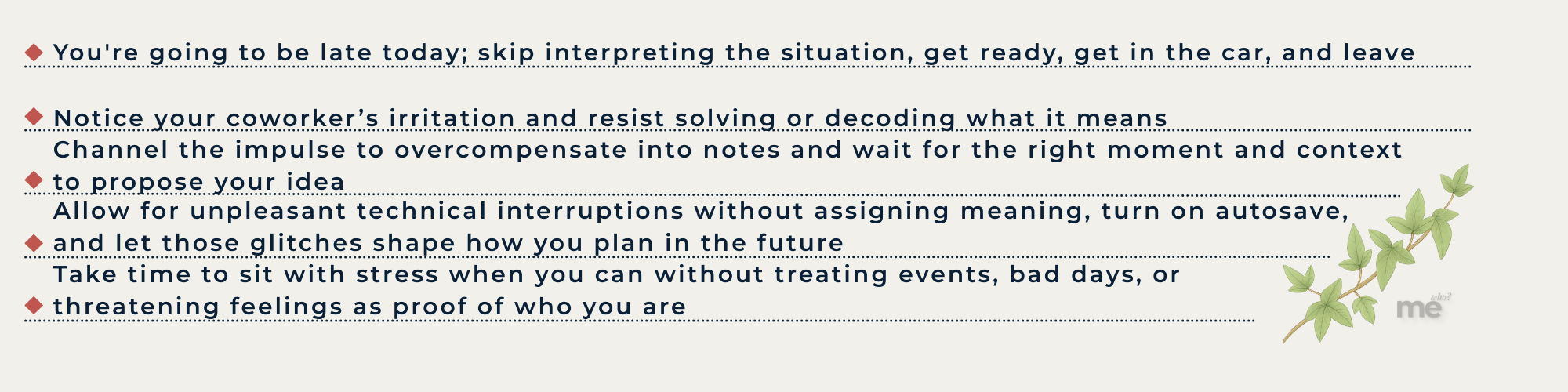
In each of these situations, you’re still honoring the feedback your mind is picking up without spinning stories out of it. Whenever this happens, you can let the uncomfortable experience stay active in your system while you choose not to interpret its meaning or treat it as a dangerous threat. It’s completely natural to feel a strong urge to explain and interpret what’s happening; that’s your mind’s conditioned response to this feeling. The goal is to let the discomfort be there without turning it into a story about who you are. Trust that you can wait until the feeling settles. When (and if) a real response is needed, you’ll be ready to meet it more calmly and clearly.
Out From Under the Blame
For a lot of people who care deeply about their work, the struggle with self-blame is very real. Knowing when to prioritize yourself, how much insight to take from a situation, and when you’re being too hard on yourself isn’t a skill most of us are ever directly taught. Real change can feel impossible when you’ve spent years believing identity-level stories like:
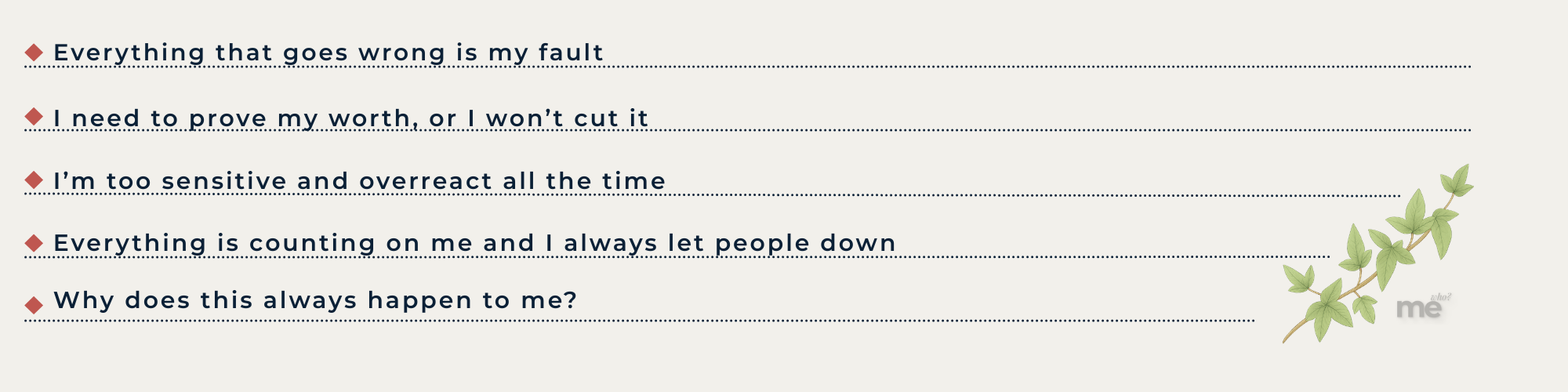
The good news is that, like riding a bike, doing a math problem, or cooking a meal, learning to see yourself more honestly while still taking accountability is a real, learnable skill. You don’t have to overreact, blame yourself, or hold yourself to endless standards just to maintain a sense of integrity. These interpretations keep you stuck in repeating situations and frame you as powerless to external circumstances. They tell you that living life on your terms isn’t compatible with doing the right thing or getting ahead.

The reality is the reverse. When you choose to hold still while the impulse to aggressively blame yourself shows up and your system is scanning for threat, you’re choosing to collect more of the available information before drawing conclusions or acting out a response. Very few situations in the modern world truly need the emergency response of immediate action. When you touch a hot stove, the impulse is to move your hand quickly. When you feel embarrassed in a meeting, that same intensity isn’t required.
You are placing trust in yourself that your system will stop spinning, and that when it does, you can choose to respond then. Many situations will require no response at all, but this doesn’t mean you won’t eventually respond to everything that happens to you. Sometimes you do have to take action: leave a situation, quit a job, end a conversation, make a project decision, or another concrete step. Do it when you’re no longer flooded by the internal urgency that drives unconscious or poorly formed decisions. When your mind steps out of threat-scanning mode again, the higher-reasoning centers in your brain get a chance to approach the problem. Your only job is to delay long enough for them to come back online.

Every time you train the muscle of noticing the self-blame spiral approaching and holding your response and interpretation, you’re strengthening your ability to respond on your own terms. Often the response you were about to make turns out to be unnecessary; you get information shortly after the moment that disproves your earlier interpretation. You’d be surprised how often this happens, and how much relief it brings when you haven’t reacted prematurely. Other times you do get confirmation that something is off, but you can respond clearly, if needed, at the right time. That difference is everything. The point is to put the power back in your hands, not in the unceasing voice of self-blame.
Letting Your Real Story Unfold
Choosing not to immediately interpret the self-blame spiral as it rises can hit you with an unsettling truth: you do not have all the answers. Learning to sit with that discomfort is the whole point. Your mind hates the feeling of incoherence that comes from not being able to make sense of the story, so it throws quick, often painful narratives at you just to stay oriented. In those situations, the real choice becomes clear: is it better to sit with the discomfort of not knowing, or grab the easiest early interpretation you can find, even if it’s a painful one? One path is short-term discomfort. The other is a life quietly shaped by a thousand small cuts.
That disordered confusion will show up whenever you step into new situations that challenge you and force growth. There will always be moments when you do not feel comfortable and do not have all the facts. The goal is to face those moments with the trust that, for now, your only job is to stay aware. The discomfort will pass. When it does, your mind has a chance to catch up, and you can decide how to respond from there. Trust yourself to make it to the soft landing on the other side of the chaos; it always comes.

The more important something is to you, the more likely the self-blame spiral is to distort it. Some situations may ask you to hold off on interpretation or reaction for several days, or even a week or two, before you can calmly see how to proceed. With time, you can learn to trust that the feeling of discomfort arrives as a cue to hold, not as a sign of impending danger.
The Only Spiral Interpretation You Need
Consider the difference in how you might read the signal when your system slips into fight-or-flight mode at work:
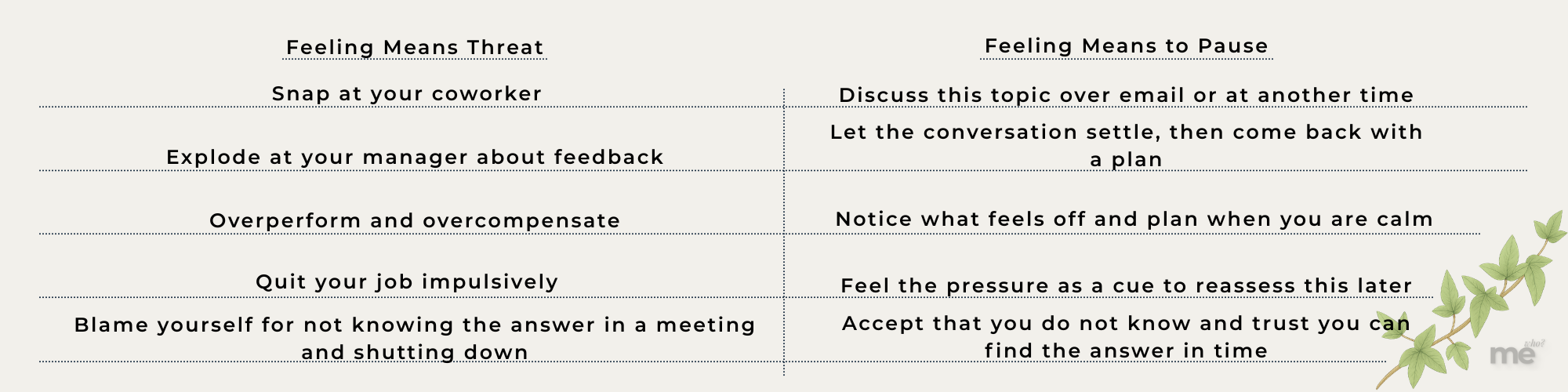
Let yourself be okay with not knowing the whole story. In every season of your life where the story changed or felt unclear, it took time for the dust to settle and the full picture to come into view. Whether you are facing a major life event or an uncomfortable moment in a meeting, the basic play is the same. Let yourself live inside a story where the pieces are still coming together whenever you can feel they are not all there yet. That is not weakness; it is discernment. It is choosing to wait for a story that makes sense: a story you had a hand in writing, instead of believing one that sabotages you at every turn.
Each time you find yourself arriving on the other side, it gets a little easier to trust that you can find it again. That is when things really start to change. Instead of clinging to fear, you start to trust in pending resolution. Fear becomes a temporary launchpad; an echo of how you used to see yourself. When you see it this way, it gets much easier to step out of your own way.

Conclusion
Blaming yourself for everything at work is exhausting. It can feel like there is no escape from the constant sense of outrunning your own mistakes. Learning to see the self-blame spiral as a repeating pattern that shows up in your day-to-day life gives you the power to change the way you respond to it.
Plenty of people who take their work seriously live with this pattern and the self-doubt that it creates; you are far from alone. With time, you can de-tune this habit and keep a deeper understanding of yourself without the painful edge.
How Does the “Blaming Myself” Pattern Show Up in Your Life?
How do you notice your personal blame spiral starting? Have you found ways of responding that give you more clarity instead of leaving you deflated? Tell us your neutral moves in the comments below.

0 Comments